

What Is Neurokinetic Therapy for Pain? A Clear Guide
NeuroKinetic Therapy · Explained
NeuroKinetic Therapy is a way of working out which muscle is causing the problem, when the painful one is only the symptom. It uses manual muscle testing to map how your body is sharing load, then treats the cause of that pattern rather than the site of the complaint.
The idea behind it
Movement is coordinated in the brain, not decided by individual muscles. When one muscle stops pulling its weight — after an injury, a period of rest, surgery, or simply years of a particular posture — the nervous system recruits others to cover. That substitution is automatic and you do not feel it happening.
What you eventually feel is the muscle doing the extra work. It becomes tight, tired and sore. Treating it brings relief that lasts a few days, because nothing has changed about why it was overloaded in the first place.
How manual muscle testing works
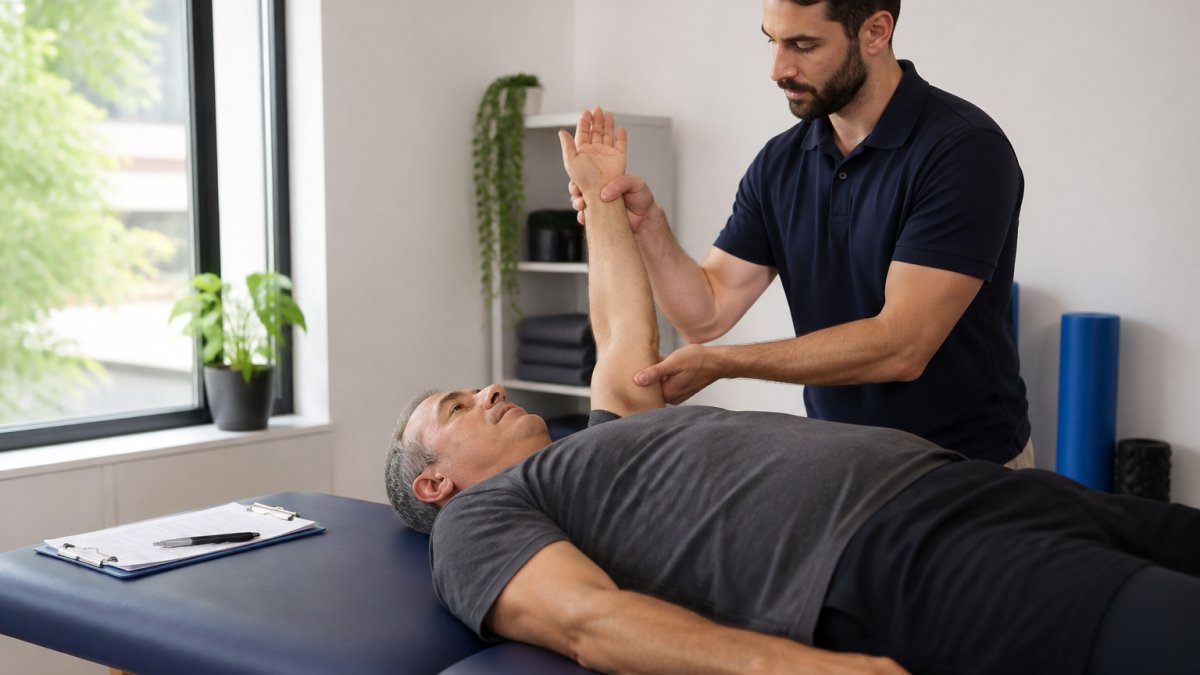
You hold a limb in a specific position and the therapist applies light resistance. The question is not how strong you are. It is whether the muscle responds crisply in that position, or gives way.
Tests in pairs
Muscles are tested in relationships rather than isolation, which is what reveals a substitution rather than simple weakness.
Release, then activate
The overworking muscle is released by hand, then the under-firing one is activated with a specific movement.
Re-test on the spot
The original test is repeated immediately. If it responds differently, the pattern has shifted. If not, the hypothesis was wrong and we look elsewhere.
That last point is the part worth understanding. The re-test is a built-in check — you are not asked to take the explanation on faith for six weeks before finding out whether it helped.
What a session looks like
Sessions run as a standard physiotherapy consultation. You do not need to book anything special or pay a different rate.
Being straight about the evidence
NKT is an assessment and clinical reasoning framework, not a treatment with a large body of clinical trials behind it. Manual muscle testing has known limitations as a diagnostic tool, and claims that it detects specific dysfunctions with high accuracy are not well supported.
What it offers in practice is structure — a systematic way to decide where to start when the obvious approach has not worked, with a re-test that tells you quickly whether the reasoning held. The treatments it leads to are ordinary and well supported: soft tissue work, muscle activation and graded loading.
Who it tends to suit
It is most useful for pain that keeps returning to the same place, injuries that recur despite completed rehab, and problems where strengthening the painful area has not changed anything. It is less relevant for an acute injury that simply needs standard management and time.
Some things need medical assessment first. Pain that is worsening at rest, pain overnight, unexplained weight loss, fever, or numbness and weakness should be investigated before any movement-based assessment.
Where to start
If your interest is a specific long-standing injury that keeps coming back, read NeuroKinetic Therapy for recurring injuries. Assessment is available at Homebush and Pendle Hill, and for persistent pain more broadly see manual therapy for chronic pain.
Frequently Asked Questions
What is NeuroKinetic Therapy?
An assessment framework that uses manual muscle testing to identify which muscles are under-firing and which are compensating, so treatment can target the cause of a pattern rather than the painful site.
Is the muscle testing a strength test?
No. It uses light resistance and looks at whether a muscle responds correctly in a given position, not how much force you can produce.
Will I know in the session whether it worked?
Partly. The muscle test is repeated immediately after treatment, so you can tell whether the pattern changed. Whether that change holds is answered over the following week or two.
Is it supported by research?
NKT itself is a reasoning framework rather than a heavily trialled treatment, and manual muscle testing has recognised limitations as a diagnostic tool. The treatments that follow — release, activation and graded exercise — are well supported.
Does it cost more than a normal appointment?
No. It is delivered within a standard physiotherapy consultation and billed at the usual rate, including under WorkCover, CTP and NDIS.
Do I need a referral?
Not for a private appointment. A referral is only needed where the funding scheme requires one, such as Medicare or DVA.
Book a NeuroKinetic Therapy assessment
Homebush, Pendle Hill, or a home visit across Sydney.