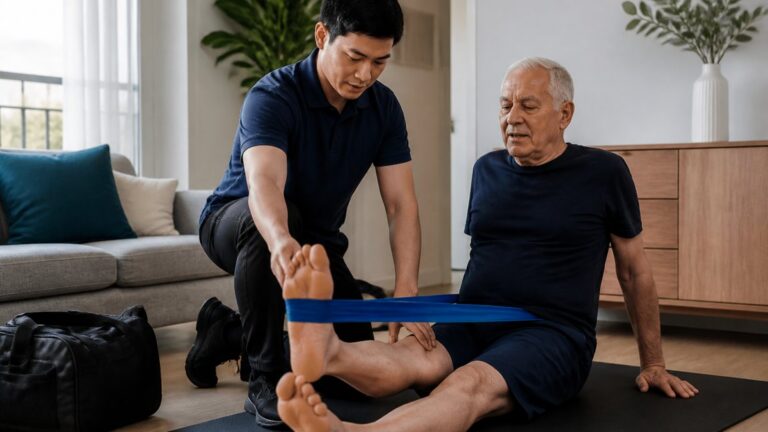

First NDIS Physio Home Visit: How to Prepare
NDIS · Your First Home Visit
Clear a space to move, have your NDIS number and plan details ready, and think about two or three everyday things you want to do more easily. Those goals shape the whole program, so arriving with them is the single most useful thing you can do.
The first home visit is an assessment, not a treatment session — and what you get out of it depends largely on what you bring to it. Nothing needs to be bought or rearranged, but a little thought about goals beforehand changes the quality of the plan considerably.

- Allow about an hour for a first visit, longer than a follow-up.
- Functional goals — specific everyday tasks — matter more than naming a diagnosis.
- No referral is needed for NDIS physiotherapy; funding usually sits in Capacity Building.
- A carer, family member or support worker is welcome and often useful.
What happens at the first NDIS physio home visit?
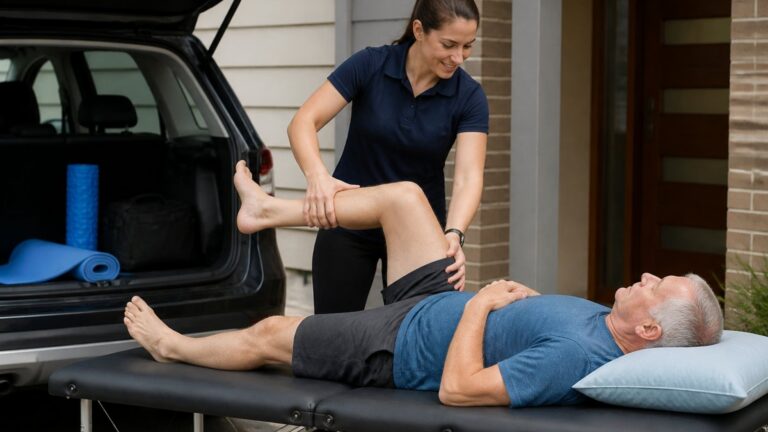
Four things, in roughly this order. A conversation about your history, your condition and what you are finding difficult. A physical assessment — strength, movement, balance, and how you manage specific tasks. A look at the environment itself. Then an initial plan and usually the first few exercises done with you.
What it is not is a full treatment session. The assessment is what makes everything after it useful, so it takes up most of the hour.
How should I prepare my home?
Minimally. Enough clear floor space to move and lie down — a lounge room is usually plenty — and a firm chair available. Nothing needs to be tidied, moved or bought.
In fact, leaving things as they normally are is better. The clutter, the rug that slides, the step you avoid: those are useful information. A home arranged specially for the visit hides exactly what the assessment is looking for.
What should I have ready?
Your NDIS details
NDIS number, plan management type, and your plan manager’s billing email if you are plan-managed.
Medical history
Current medications, relevant diagnoses, recent surgeries, and any scan or specialist reports you have.
Equipment you use
Walking aids, braces, splints, shower aids — have them out rather than put away.
Your goals
Two or three specific things you want to do more easily. This is the one worth thinking about in advance.
What makes a good NDIS goal?
Specific and functional. “Get stronger” gives a physiotherapist very little to work with. “Get up from my chair without pushing off with both arms”, “walk to the letterbox and back without stopping”, “shower standing rather than seated” — each of those names a task, which can be assessed, measured and built towards.
Good goals also connect to the goals written in your NDIS plan, which is what makes the support demonstrably reasonable and necessary. If you are unsure how your plan is worded, have it open during the visit and go through it together.
Who else can be there?
Anyone you want. A family member, carer or support worker is welcome, and it genuinely helps where someone else assists with transfers or will be supervising your exercise program — they learn it in the place it will actually be done.
Your information is confidential. Where reports go to a plan manager, support coordinator or the NDIA as part of a plan review, that happens with your consent, and you can ask what any report says before it is sent.
What about pets and sensory needs?
Pets are not a problem, though somewhere settled for them makes the session easier for everyone. If noise, lighting, touch or unfamiliar people are difficult, say so when booking rather than on the day — the session can be paced differently, kept shorter, or split across two visits.
Tell us beforehand what makes appointments hard. Time of day, fatigue patterns, communication preferences, who should be present. All of it can be planned around if we know.
What happens after the first visit?
You should finish with a clear idea of what was found, what the plan is, and what to do before the next session. A written program follows, and where it is needed we provide reports documenting progress against your goals for plan reviews.
Related reading
Funding and plan types are covered in NDIS home visit physiotherapy, invoicing in NDIS physiotherapy billing, and the booking process in how to book mobile physiotherapy. If you are weighing home visits against attending a clinic, see is a home visit worth it. Our coverage is set out in mobile physiotherapy.
Frequently Asked Questions
How long does a first NDIS physio home visit take?
Around an hour. Most of that is assessment — history, physical testing and looking at how you manage tasks in your own environment. Follow-up visits are usually shorter.
Do I need a referral for NDIS physiotherapy?
No. What matters is that the support is reasonable and necessary and relates to the goals in your plan. No GP referral is required.
Should I tidy my home before the visit?
No, and it is better if you do not. The way your home normally is — including the obstacles you work around — is useful information for the assessment.
What should I wear?
Something comfortable you can move in, and have your usual footwear nearby if walking or balance are part of what you want to work on.
Can my support worker or family member stay?
Yes. It often helps, particularly where they assist with transfers or will be supervising your exercises between sessions.
Which part of my plan pays for it?
Physiotherapy usually comes from Capacity Building — Improved Daily Living, which covers allied health assessment and therapy. Some plans are written differently, so check yours or ask your support coordinator.
Arrange your first NDIS home visit
Across Sydney metropolitan areas.